The Three Foundations of a Great Content Strategy
It recently snuck up on me that somehow, someway, I’ve been creating marketing content for more than twenty years now.
Wow.
I’ve been fortunate to have had the opportunity to create work that’s captured the attention of museum visitors, IT professionals, healthcare consumers, physicians, and even gas utility operators (!).
At first glance, those audiences have almost nothing in common. Yet the approach I’ve taken to produce effective content has been remarkably similar across each of these industries. I believe good content strategy comes down to three foundational truths:
Understand the customer
Understand the product
Understand the customer journey
When those three things are clear, the content almost writes itself.
1. Start by Understanding the Customer
Many marketers begin with the product. They’re excited about their offering and want to talk about features, specifications, and capabilities. That’s a mistake.
The most important foundation for great content is deeply understanding the customer—their challenges, pressures, and motivations.
What keeps them up at night?
What are their biggest pain points?
What are they trying to accomplish?
What obstacles stand in their way?
If you’re working in a large organization, someone may have already developed personas you can use that paint a few generalized pictures of your customers and answer some of these questions. These can be extremely valuable—but only if they’re current and grounded in real conversations and data.
Some of the best ways to gain insight into your customers include:
Reviewing and refreshing persona research
Talking directly with customers–attend a trade show, join a sales call, or engage with your Customer Advisory Board (if your company has one)
Spending time with the sales team
Sales teams in particular are an underutilized source of insight. They are on the frontlines and hear customers’ needs, questions, objections, and concerns every single day.
Those conversations are gold.
When I was working at Xylem, for example, conversations with utility managers revealed the real challenges they were facing: the need to modernize aging infrastructure and be more efficient while navigating tight municipal budgets and evolving safety regulations.
At Alo Solutions, I heard a very different—but equally powerful—story from physicians. Many were dealing with crushing administrative burdens: charting in the evenings and weekends, dealing with bureaucracy (prior authorizations, reimbursements), worrying about staffing, and even managing marketing for their practices.
These insights mattered far more than any product specification sheet and helped me prioritize and shape the content we created to ensure it spoke directly to the realities our audiences were facing.
2. Understand the Product (and What Actually Matters)
Once you understand the customer, the next step is understanding your product—deeply.
What problem does it actually solve?
What makes it different from the competition/alternatives?
Which features truly matter to customers, and which ones are just nice to have?
Earlier in my career, I worked at Second Story, an interactive studio that produced digital exhibits for museums and cultural institutions. One month I was collaborating with a curator who knew more about dinosaurs than almost anyone on the planet. The next month it might be postage stamps or Native American baskets.
In those projects, the “product” was knowledge–and sometimes artifacts. But the challenge was always the same: deciding what information mattered most to the audience.
We often structured content into prioritized layers:
Top tier: The essential story every visitor should understand
Second tier: Additional context for people who want to learn more
Third tier: Deep detail for the most curious visitors
This layered approach applies just as well in B2B marketing.
Large purchasing decisions are rarely made by a single person. Instead, teams are involved—each with different levels of interest and expertise. Some stakeholders want a quick understanding of the value proposition. Others want to go deep into the technical details.
Good content strategy makes room for both.
3. Map the Customer Journey
The third critical element is understanding the customer journey.
Content shouldn’t be created in a vacuum–it should be tailored to support and engage the user where they are along their path from discovery to adoption to retention. In most B2B environments, the journey includes several stages:
Discovery
At this stage, prospects may not even know your company exists. Content should focus on industry trends, challenges, and perspectives so that your organization comes across as a trustworthy and credible voice.
Evaluation
Once prospects begin exploring solutions, they need deeper educational materials. This is where guides, webinars, product explainers, and comparison content become valuable.
Decision
In this stage, prospects need proof. Real-world case studies and ROI calculators can help decision-makers feel confident they’re making the right choice.
Onboarding and Retention
Content doesn’t stop after the sale. Welcoming guides, tutorials, and best-practice resources help customers succeed—and ultimately become advocates.
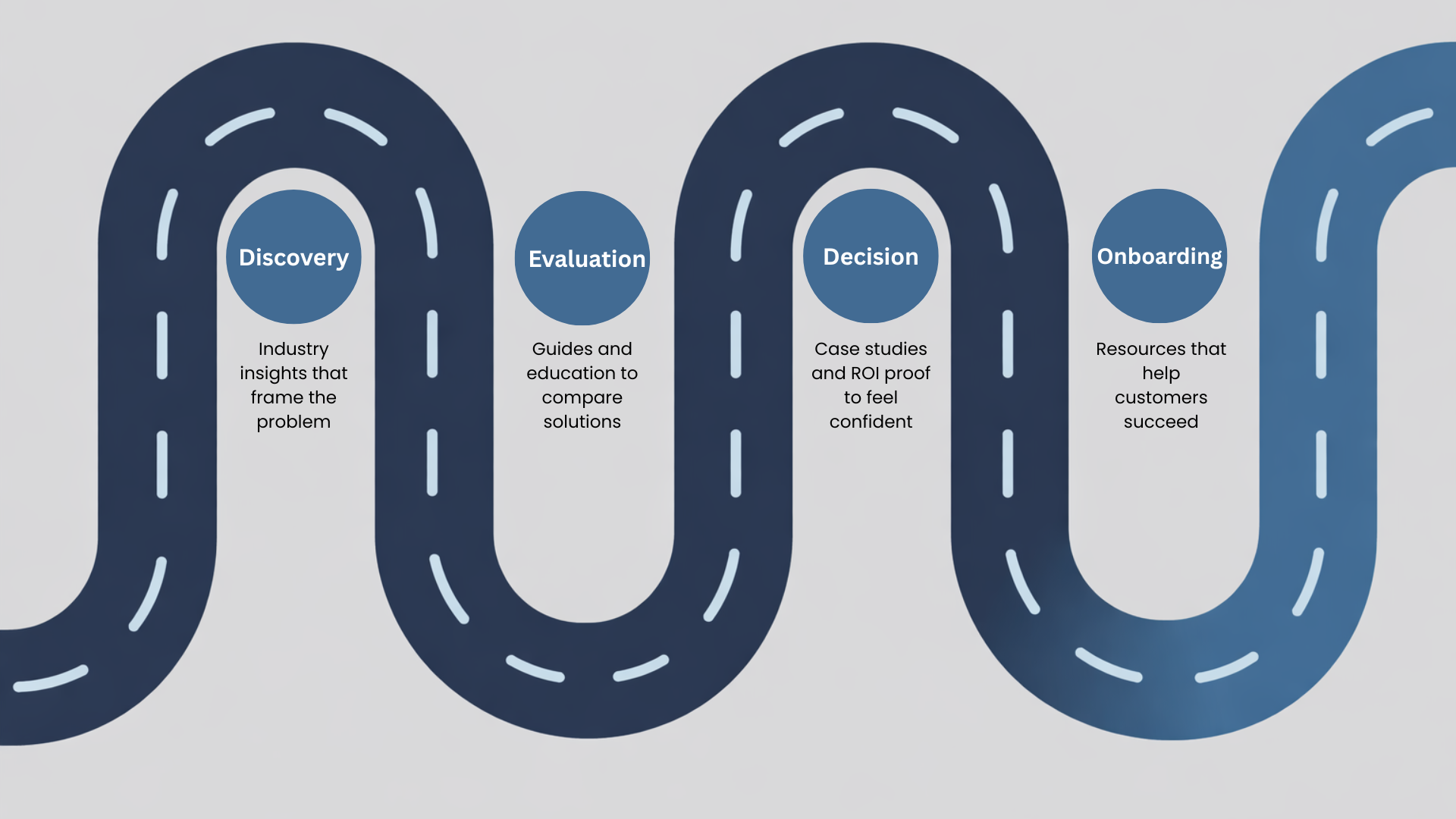
A Typical B2B Customer Journey
One principle I’ve seen repeatedly is that content should become more specific as the journey progresses. Early-stage content should be more aspirational and problem-focused. You’re not selling yet—you’re helping the audience imagine a better outcome. Later-stage content can introduce features, specifications, and implementation details. And even later, tips and tricks and optimizations.
Content Strategy Is Ultimately About Empathy
Over the years, marketing tools have evolved dramatically. We now have advanced analytics, marketing automation platforms, SEO/GEO optimization tools, and even AI writing assistants. But the fundamentals of great content strategy haven’t really changed–it still begins with empathy.
If you understand your customer’s world, understand the value your product brings to that world, and create content that aligns with the journey they’re on, you’re already most of the way there. Everything else—formats, channels, technology—is just execution.
And after twenty years of doing this work, I’ve found that the best content strategies always start the same way: By listening first.
